
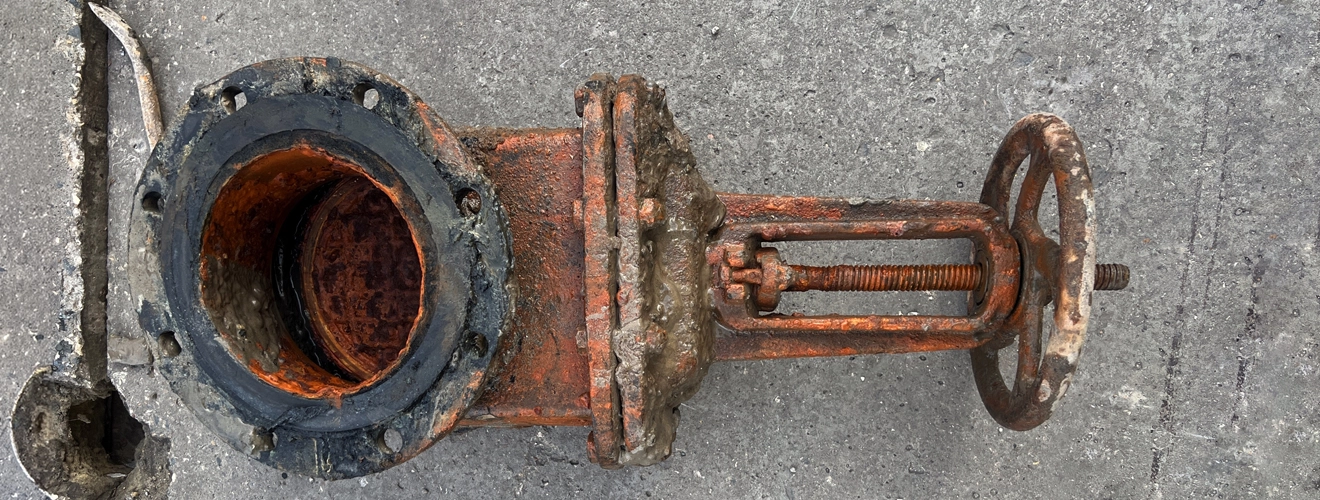
Companies in the water and process industries are continuously under pressure to reduce costs without compromising performance and reliability. A common reflex is to opt for cheaper components in installations, such as the choice for gate valves in underground infrastructure. On paper, this seems like a smart saving. In practice, it often turns out to be quite the opposite. The total lifecycle costs of gate valves are significantly underestimated.
Why Gate Valves are Crucial
Gate valves play an essential role in underground piping networks for water and other media. They must reliably open and close under all circumstances. Precisely because they are often used underground, maintenance is complex and costly. A defective gate valve is therefore rarely a minor problem.
Most Common Failures
Research among various water utility companies shows that gate valves frequently fail in practice. The main causes:
- 22% → Gate jammed; no longer closes.
- 20% → Corrosion (rust).
- 20% → Leaks at connections (e.g., flange).
These problems occur significantly more often with lower quality valves.
What Goes Wrong with Cheap Valves?
The cause almost always lies in product quality and design:
- Insufficient control of tolerances → moving parts wear out faster or block.
- Inferior coatings → increased risk of corrosion (rust).
- Poor material choice → brittleness, cracking, and cavitation problems.
- Design flaws → sharp edges, gaps, and complex geometries that further accelerate corrosion.
- Unreliable seals → leaks and water loss.
In short: small deviations in production lead to major problems in the field.
The Hidden Costs of Low Quality
The purchase price is only a fraction of the total costs. When a gate valve fails, costs rise significantly, not to mention inconvenience and disruption:
Direct Costs
- Excavation and dismantling.
- Repair or replacement.
- Extra material usage.
Indirect Costs
- Production loss and downtime.
- Water loss due to leaks.
- Damage to other infrastructure from leaking water.
- Delay of other work and projects; planning issues.
Social and Reputational Damage
- Inconvenience and disruption.
- Damage to image with customers and stakeholders.
- Risks to safety and the environment.
A jammed valve that fails to shut off a pipe when needed can exponentially increase the impact.
Total Cost of Ownership: The Right Consideration
Those who only look at the purchase price make an incomplete decision. The right question is: What does this gate valve cost over its entire lifespan?
High-quality gate valves:
- prove to last longer;
- require less maintenance;
- drastically reduce the chance of failures;
- limit risks and unexpected costs.
Thus, they pay for themselves more than enough in practice.
Sustainable Choice: Investing in Quality
A reliable installation starts with components you can trust. Quality valves are designed for long-lasting performance under tough conditions.
An example of this is Hawle gate valves (up to DN 600), which are used worldwide in water distribution networks. Thanks to high-quality materials, consistent production, and strict quality standards, they offer:
- long lifespan;
- minimal risk of failure;
- reliable sealing, even after years of use;
Additionally, these products are manufactured in Europe under controlled conditions, with attention to sustainability and working conditions.
Conclusion
Skimping on gate valves seems attractive, but in many cases leads to higher costs, more risk, and unnecessary disruptions.
The real savings are not in the lowest purchase price, but in maximum reliability.
Want to know more?
Imbema Denso BV is certified according to ISO 9001, ISO 14001, ISO 27001, CSR performance ladder, and CO2 performance ladder.