
Choose the best professional wet and dry vacuum cleaner for industrial use.
When the suction power of an industrial vacuum cleaner decreases, attention is often immediately directed to the filter. That makes sense. As a filter fills up with dust, the machine has to work harder to move the same amount of air. The result is a lower airflow and ultimately less performance. Many manufacturers solve this with an automatic or manual filter shake function. As soon as the filter becomes dirty, it is shaken or vibrated so that accumulated dust comes loose. The airflow then increases again and the machine can continue to operate.
On paper, this sounds like a smart solution. But if you look more closely at what happens during use, you’ll see that the airflow actually fluctuates continuously. The vacuum cleaner starts with a high airflow. As the filter fills, that airflow decreases. At a certain point, the shaking function is activated, and the airflow increases again. Then the same cycle begins again from the start. So the system temporarily fixes the problem each time, but doesn't prevent it from occurring.
A Different Way of Thinking
At IPC, the issue is viewed from a different perspective. Instead of focusing on restoring flow loss, the emphasis is placed on reducing filter contamination. This is achieved by tailoring the filter structure to the application. For standard dust, a standard filter often suffices. For finer dust types, a fine dust filter or the patented IPC Carbon Filter can be used. The goal is simple: to prevent large amounts of fine dust from reaching the main filter. The less strain on the main filter, the more stable the airflow remains. During practical tests, this is clearly visible with a manometer. While a vacuum cleaner with a filter shaking system shows a constant pattern of decline and recovery, the flow of a correctly configured IPC machine remains much more constant throughout the work process.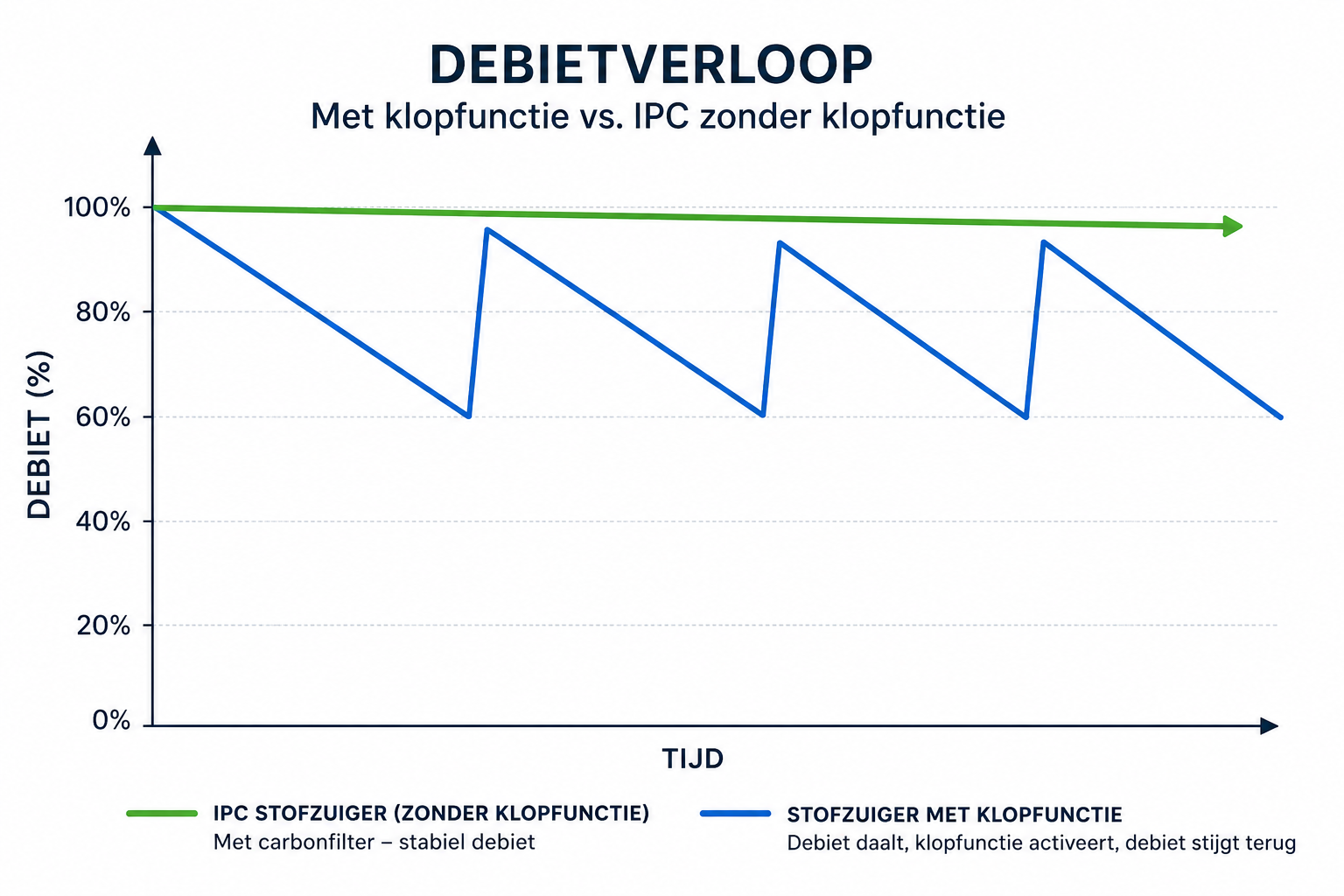
Why a stable flow rate is more important than peak performance
When it comes to industrial vacuum cleaners, maximum suction power is often a key focus. However, in practice, this doesn't tell the whole story. A machine that delivers high suction power for a short period but significantly drops throughout the workday might ultimately be less effective than a machine that starts slightly lower but maintains its performance steadily. It's comparable to a truck that consistently drives at 90 kilometers per hour versus a truck that keeps accelerating and decelerating. In the end, predictability is often more valuable than peak performance. The same goes for dust extraction. Operators want to know what they can expect throughout an entire workday, not just what a machine achieves immediately after being switched on.The role of the patented IPC carbon filter
An important component of this approach is the patented IPC Carbon Filter. This filter is designed to capture very fine dust particles before they can burden the main filter. As a result, the main filter stays cleaner for longer and the airflow can remain stable without the need for a shaking mechanism. This difference is not only visible in measurements but also in practice.The simple solution is often the best
Filter shake systems definitely have their place in certain applications. They are designed to limit the effects of filter clogging and can work effectively in many situations. However, IPC opts for a different approach. By choosing the right filter for the type of dust being vacuumed, the load on the main filter is limited and the flow rate remains more stable. This results in a simpler system with fewer moving parts, less maintenance, and consistent performance over longer periods of use. And ultimately that's what it's all about: not temporarily restoring suction power, but maintaining it for as long as possible.
Scroll for more

