
Disposable masks: what you weren’t told but need to know

Working safer with more sustainable equipment. That is the path employers and employees have chosen. Despite the intention to work safely with sustainable means, in practice it often turns out differently. This becomes clear when you see how often disposable masks are still used—ironically, a far from sustainable PPE with a questionable reputation regarding reliability and actual protection.
Misconceptions
Research firm RPD Forst & Sullivan conducted a market study years ago on the distribution of different types of respiratory protection. It showed that in Western Europe, as much as 37% of all respiratory protection sales come from disposable masks, while sustainable options—half masks and full-face masks with filter cartridges—account for just under 21% of sales. This situation appears to have changed little, partly due to COVID-19. In fact, the share of disposable masks seems to have grown even more. This is partly due to misconceptions about sustainable masks and disposable masks.
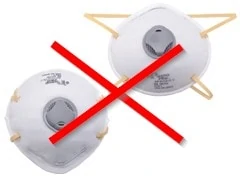
Exhaling is tiring
Humans have muscles that expand the diaphragm and rib cage, allowing air to be inhaled. When these muscles relax, the lung volume decreases, and air is exhaled. Unlike inhaling, exhaling normally requires no muscle effort. However, if the exhalation resistance increases, you must exert force and use muscles to breathe out—similar to the effort needed to blow up a balloon. Humans are not trained to use muscles for exhaling, so over time this becomes quite tiring. That’s why it’s important for a mask to have as low an exhalation resistance as possible. This can be achieved, for example, by using large exhalation valves.
Leakage along the face seal
A proper seal on the face is very important. If it is not tight, contaminated air can still be inhaled along the face. Compared to disposable masks, a reusable half mask or full face mask will always provide a better seal—especially when the reusable mask is made of snug-fitting silicone. However, users must be instructed on how to properly use and maintain these masks. For example, when using tight-fitting respiratory protection, users should start the job clean-shaven. Beards are a no-go. Even stubble can cause leakage along the face seal. Interestingly, some disposable masks feature so-called “comfort cushions” on the sealing surface, but the texture of these cushions actually increases the risk of leakage along the face.
Electrostatic Filter vs. Mechanical Filter
Not every filter used for respiratory protection has the same properties. The filter material is decisive. Two types of materials are used: electrostatic and mechanical.
Electrostatic Filters
Disposable masks are almost all made from electrostatic filter material. The static charge of this material attracts and holds particles, similar to the magnetic paperclip holder on your desk. But the more paperclips stick to it, the fewer new paperclips will cling. The same applies to a disposable mask: as the filter captures more particles, its filtering effectiveness decreases, allowing more particles to pass through unnoticed. Higher temperature and humidity worsen this effect. A disposable FFP1 mask "leaks" the most, while an FFP3 leaks the least.
Mechanical Filters
Sustainable masks often feature replaceable mechanical filters. A mechanical filter works like a kitchen sieve: paperclips simply can’t pass through. The fuller the filter becomes with particles, the better its filtering performance. In fact, the chance of a particle slipping through decreases as more particles are captured. Mechanical filters are available with an efficiency of up to 99.997%, which is significantly better than the minimum standard of 99.95%.
So why still use disposable masks?
The answer is simple: a disposable mask is intended for occasional use, when the level of exposure allows it. For example, if you only need respiratory protection for 5 minutes to sand a board or cut a tile, investing in a reusable half mask might be a bit too costly. However, if you need respiratory protection more frequently, then it’s no longer occasional use. And if costs are still holding you back, don’t worry—reusable masks are definitely more cost-effective in the long run!
Sustainable is cheaper with significantly less waste
A good sustainable mask will definitely be hundreds of euros cheaper per year than disposable masks when used daily. If multiple employees use respiratory protection, this can save thousands of euros annually. Additionally, using a sustainable mask means working safer and producing significantly less waste. Disposable masks must be treated as chemical waste, which makes the waste stream even more expensive.
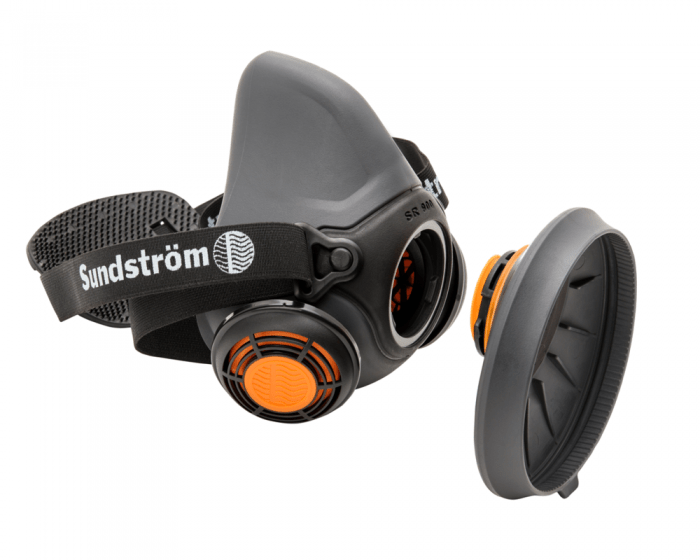
6 Key Facts at a Glance
Here are the 6 most important facts regarding disposable masks summed up for you:
- A disposable mask has higher inhalation and exhalation resistance than a well-chosen sustainable mask.
- A disposable mask fits the face less well than a well-chosen sustainable mask.
- A disposable mask allows harmful particles to pass through, whereas a good sustainable mask with a mechanical filter provides certainty.
- Using disposable masks often costs more than using a sustainable mask.
- A well-chosen sustainable mask offers much more protection than a disposable mask.
- A well-chosen sustainable mask is often more comfortable than a disposable mask.
Advice from Our Experts
Here is another piece of advice from our respiratory protection experts:

Still using disposable masks? Then switch to a half mask with filter cartridges. It’s not only cheaper but also safer and produces less waste.
