How is measurement data transmitted?
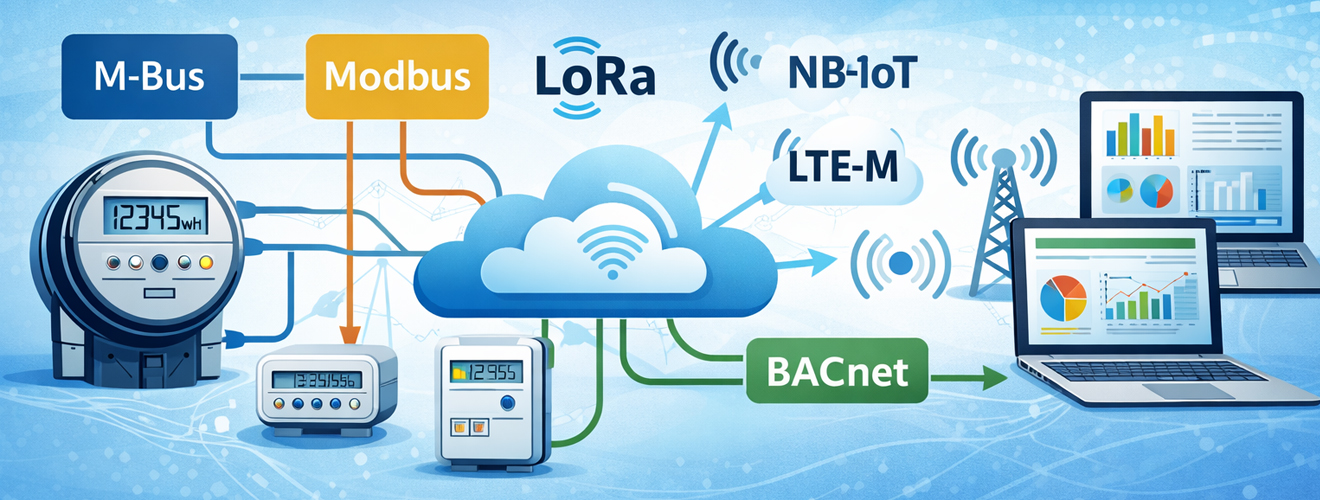
Explanation of M-Bus, Modbus, LoRa, NB-IoT, LTE-M, and BACnet
In an intermediary metering system, measurement is only the first step. Equally important is the data communication: how do you ensure that the measurement data is transmitted safely, reliably, and efficiently to a dashboard or energy management system?
Depending on your project, building type, and technical requirements, various technologies are available. Below we explain the five most commonly used communication technologies: M-Bus, Modbus, LoRa, NB-IoT, and LTE-M.
M-Bus (Meter-Bus)
What is it?M-Bus is a wired communication system specifically developed for reading meters, such as heat meters, water meters, and gas meters.
Features:- Reliable and interference-free (due to cabling)
- Uses a 2-wire bus structure and/or wireless M-Bus
- Very suitable for larger buildings with many meters
- Can connect dozens of meters on one line
- No battery needed in the meter (powered via the bus)
When to choose this?
For new construction or renovations where cabling can be easily installed and reliability is a priority.
Modbus
What is it?Modbus is a universal protocol widely used in the industry and building management systems (BMS). It typically operates via an RS485 bus or via TCP/IP.
Features:- Data is available in real-time
- Robust and flexible
- Widely used in electrical installations and industrial applications
- Supported by many PLCs and BMS systems
- Fast and structured data communication
When to choose this?
For integration with existing industrial automation, electrical installations, or if Modbus-compatible hardware is already present.
LoRa (Long Range)
What is it?LoRa is a wireless communication protocol for longer distances. The narrow bandwidth limits the size of the data packets, but with very low power consumption.
Features:- Suitable for sending small data packets
- Large range (up to several kilometers)
- Low data rate, but sufficient for meter readings
- Works via private network or via public LoRa networks
- Very energy-efficient → long battery life
When to choose this?
When you want to set up an integrated building management system in which various installations (HVAC, lighting, energy) work together seamlessly. Ideal for large buildings or complexes where interoperability between different brands and systems is essential.
Comparison at a glance
| Technology | Wired / Wireless | Range | Power Consumption | Typical Application |
| M-Bus | Wired | Indoor | Low (via cable) | New construction, commercial buildings, housing associations |
| wM-Bus | Wireless | Indoor | Low (via cable) | New construction, commercial buildings, housing associations |
| Modbus | Wired | Indoor | Low | Industry, electrical installations |
| LoRa | Wireless | Up to several kilometers | Ultra low | Holiday parks, heritage buildings, retrofits |
| NB-IoT | Wireless (cellular) | Very large | Very large | Municipalities, nationwide installations |
| LTE-M | Wireless (cellular) | Very large | Low to moderate | Real-time sensor data, mobile use |
| BACnet | Wired (IP or MS/TP) | Indoor | Low | Building management systems (HVAC, lighting, energy) |
Conclusion
Every situation demands a different approach. At Imbema, we look at each measurement project by considering:- Your building(s) and installation
- The desired measurement frequency
- Available infrastructure
- Requirements for reporting, monitoring, and scalability
This way, we jointly determine the right communication technology – ensuring that your meters do not only measure, but also provide genuine insights.