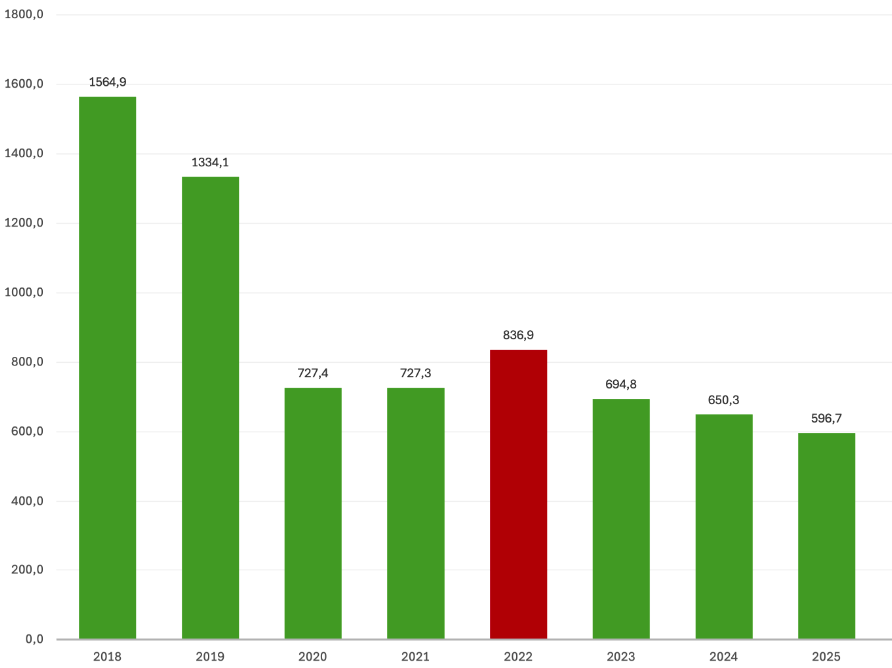
Imbema has made another clear step forward in reducing its own CO₂ emissions. In 2025, our emissions amounted to 596.7 tons of CO₂. This means that the emissions are now more than 14% lower than in our reference year 2023.
We take responsibility for our impact on the climate. That is why we have been investing substantially over the years in reducing our CO₂ footprint. Our goal is clear: by 2030, we want to have reduced our CO₂ emissions within scope 1, scope 2, and scope 3 business travel (CO₂ performance ladder level 3) by 50% compared to the year 2023.
On the way to 50% less CO₂ by 2030
In 2023, our CO₂ emissions were 694.8 tons. To achieve our goal for 2030, this must be reduced to a maximum of 348 tons. This requires structural measures and a critical review each year to identify further savings.
In 2024, our emissions had already decreased to 650.3 tons of CO₂, a reduction of 6.4%. In 2025, we continued this downward trend to 596.7 tons.
For 2025, we had set an interim goal to reduce emissions by 10% compared to 2024. With an actual reduction of 8.24%, we did not fully achieve that goal. At the same time, the result means that we have managed to prevent almost 100 tons of CO₂ emissions over two years.
Compared to our first reporting year 2018, we have realized a significant reduction of 968 tons or nearly 62%. We are particularly proud of that.
Electrification of vehicle fleet
A significant part of the reduction comes from the greening of our vehicle fleet. Since mid-2024, we have been adding only electric and plug-in hybrid passenger cars to our fleet. In 2025, the effects of this became increasingly visible. Additionally, our fleet has been exclusively charged with green Dutch solar power since 2025. This further reduces the CO₂ emissions of our mobility as more conventional vehicles are replaced.
Buildings becoming more energy-efficient
In 2025, we focused more intensely on the energy consumption of our buildings. Employees were encouraged to use heating more consciously: an empty office space does not need to be heated. Local additional measures were also taken. In Haarlem, for example, air conditioning with inverter technology was used more frequently to heat more efficiently with green Dutch energy from wind power. In Vlaardingen, the temperature in the warehouse was lowered and the office was partially electrically preheated.
Gas consumption did not decrease everywhere. At our facility in Nieuwerkerk a/d IJssel, natural gas consumption increased somewhat. Therefore, we continue to closely monitor the energy consumption of our locations to explain deviations and find new savings opportunities.
Continuing to improve
Against the savings achieved, there was a higher emission from air travel in 2025. This increased by 14 tons of CO₂ compared to 2024. Nevertheless, Imbema was able to further substantially reduce the total emissions again. The results show that the measures we are taking are effective. At the same time, we are not there yet. In the coming years, we will continue to invest in further electrification, biofuels, more energy-efficient buildings, and other opportunities to structurally reduce our CO₂ emissions.
The ambition for 2030 remains: 50% less CO₂ emissions compared to the year 2023, and thus a demonstrably smaller climate impact from our business activities.