
Malfunctions in car wash systems resolved with waterproof Monocal grease
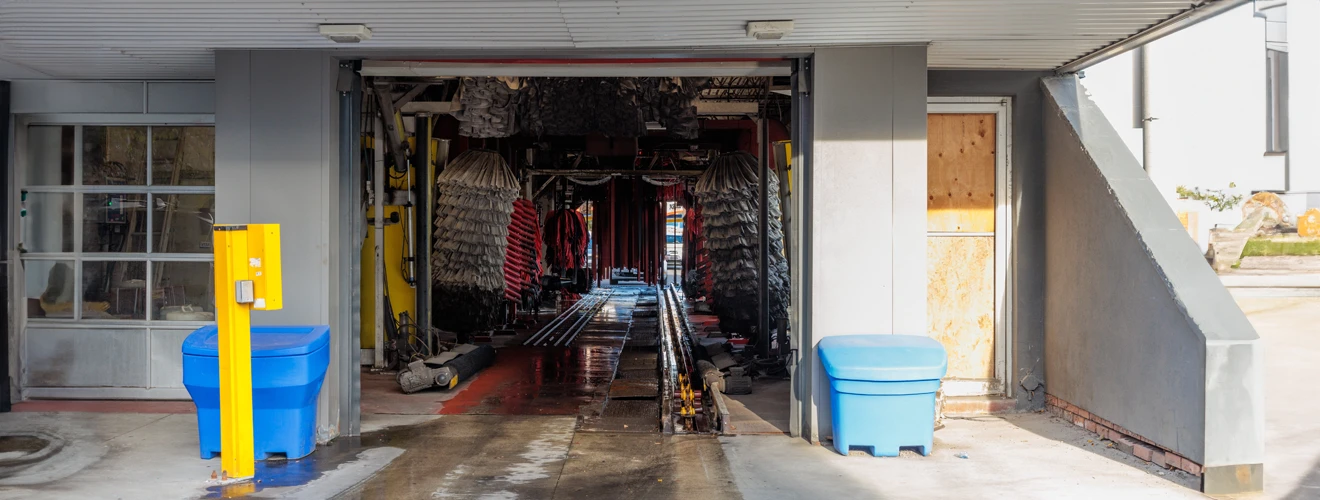
There are circumstances that make reliable lubrication of machines and equipment particularly challenging—such as moving parts that come into contact with water. Add degreasing agents to that water, and you’ve got a headache for any maintenance technician or asset manager. This was the case for busy car wash systems that repeatedly experienced mechanical issues due to insufficient lubrication.
Guide system the main headache
In the U.S. state of Michigan, a large chain of car washes is in operation. As is common nowadays, these car washes are fully automated. You drive the front wheel of your car onto a type of guide block that moves along a rail, pulling the vehicle through the wash tunnel. That guide system was the main headache for the car wash operator.
Almost daily reapplication of grease
The guide blocks are pulled along a guide rail by a cable system. The weight resting on a block can reach several hundred kilos. Grease ensures that the guide block doesn’t seize on the rail. The car wash manufacturer therefore recommends that, in case of intensive use, the guide blocks be checked daily and re-greased if necessary.
Letting in-house staff handle it
Having an external maintenance service check and lubricate the system would significantly cut into profits. So the decision was made to have in-house staff perform these tasks daily before opening. These employees, however, were not trained to detect problems—let alone carry out lubrication maintenance properly.
Angry customers and costly repairs
Unfortunately, lubrication was sometimes forgotten or done incorrectly, causing the guide pads to seize on the rail. This meant the entire car wash had to be shut down, often with multiple cars stuck inside that had to be pushed out by hand from the soaking wet wash area. The consequences were very angry customers and expensive repairs, forcing the car wash to close for a significant part of the day and suffer substantial losses.
Grease washed away too quickly
Eventually, the operator consulted experts from the maintenance service. They suspected that the grease was being washed away too quickly due to the combination of water and soap. They decided to have a specialist from Lubrication Engineers propose a solution. The specialist reached the same conclusion and offered to start a trial with Monocal GP grease in several car washes after demonstrating a spray-off test.
Watch the spray-off test in this video:
Smeervet spoelde te snel weg
Uiteindelijk ging de exploitant alsnog in gesprek met deskundigen van de onderhoudsdienst. Zij vermoedden dat het smeervet door de combinatie van water en zeep te snel weggespoelde. Men besloot om een specialist van Lubrication Engineers met een oplossing te laten komen. Die trok dezelfde conclusie en bood aan om, na een demonstratie met een spray-off test, in enkele wasstraten een proef te starten met Monocal GP vet.
Bekijk de spray-off test op deze video:
Re-lubrication only needed after 2–4 weeks
The test results showed that guide blocks lubricated with Monocal GP grease only needed to be re-greased after 2–4 weeks. This allowed the operator to decide to have the lubrication professionally carried out by the contracted maintenance service. Since switching to Monocal GP, there have been no more issues with seized guide blocks in the car washes. As a precaution, the operator also introduced Monocal GP grease in all other car washes.