
People with beards wearing respiratory protection are at risk

Employers must do everything possible to protect their workers from health damage, such as by providing personal protective equipment like respiratory protection. But if a mask wearer decides not to shave for a day, the employer immediately faces a problem. Let alone if the wearer grows a full beard. The protection factor of such a mask then decreases dramatically. People think they are protected but end up inhaling hazardous dust, gas, or vapors.
Seal Between Mask and Face Partially Determines Protection
Disposable masks, half-face masks, and full-face masks are types of negative pressure respiratory protection. When inhaling, air flows through the filter into the mask. The seal between the mask and the face must be secure; otherwise, contaminated air can still be inhaled. When this seal is perfect, the nominal protection factors described in the standard can be expected for these types of masks:
| Mask Type | Filter Type | Protection Factor |
| Disposable | FFP2 | 12 x |
| Half-face | P3 | 50 x |
| Full-face | P3 | 1000 x |
Not shaving dramatically reduces protection factor
The values in the table were determined in laboratories with a mask on a clean-shaven face. But if the wearer does not shave for one day, these numbers become worthless. This is shown by a study from Sundström Safety AB, a manufacturer of respiratory protection. They took an SR 100 silicone half mask and tested it on several subjects with varying beard growth. The protection factor, the degree of protection, decreased dramatically as the face remained unshaven longer.
| Beard growth | Decrease in protection factor |
| 1-2 days | > 50% |
| Full beard | > 99% |
For other brands, the protection factor decreased even further with a 1-2 day beard.
Shaving the beard off? Not always an option for everyone
The effectiveness of respiratory protection demonstrably decreases if the wearer does not shave. So much so that a dangerous concentration of polluted air is still inhaled, causing health damage to the wearer. The face must be smooth, so the beard has to go... But that is not always an option for everyone. Beards are fashionable! Additionally, a beard may be worn for cultural or religious reasons. For those situations, there is still a reliable and comfortable solution: a positive pressure system.
How a positive pressure system works
In respiratory protection with positive pressure, clean air is blown into the mask from the outside. Such a system can be an external compressed air compressor with a separate filter unit, but also a motor unit worn on the back. The clean air is supplied via a hose to a hood worn on the head. This hood covers the face. Clean air is then blown out of the hood again. Due to the positive pressure in the hood, contaminated air from outside has difficulty entering. This protects the wearer.
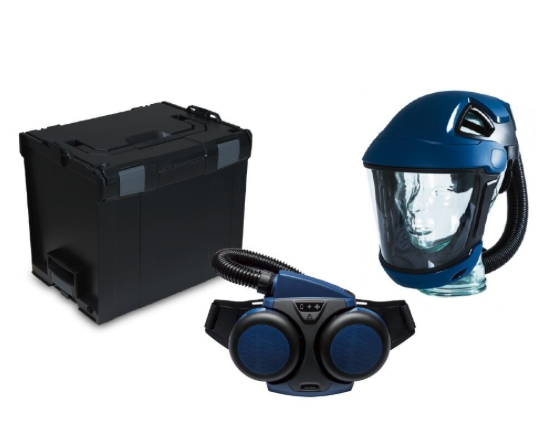

No longer affecting the level of protection
The advantage of this system is that a beard no longer affects the level of protection. The protection factor remains guaranteed, making it ideal for beard wearers. All hoods with a protection factor of TH3 offer a nominal protection factor of 500x. This means these hoods provide much better protection than a regular half mask with a P3 filter (50x).