
Preventing hazardous situations during lubrication of rotating machinery

One of the industries where our people frequently work on-site is the food industry. For a specialist in lubricants, the conditions there are challenging. Special lubricants that are food-safe yet still perform adequately must be used. Our LE lubricants deliver on food safety and reliability. However, when it comes to workplace safety, we occasionally encounter risky situations, such as during lubrication maintenance on rotating machinery. This hazardous work can easily be avoided. Here is the story of one of our specialists who encountered such a situation and provided a safe solution.
Invited to solve a lubrication problem
The company in question produces food products. We were invited by the maintenance manager to solve a lubrication issue. The grease they were using proved unable to withstand the high ambient temperature, resulting in malfunctions and downtime. We offered to conduct a test with our LE 4051 H1 high temperature grease. One of our specialists visited the site to assess the situation.
Witness to a near workplace accident
When our specialist entered the production area heading towards the oven, he saw a technician with a grease gun under a rotating conveyor belt. While the technician was maneuvering the grease gun between the machines, the sleeve of his overalls briefly caught on one of the rotating parts. He was able to pull free quickly but ended up with a scratch. Our specialist witnessed a (near) workplace accident. Concerned for the technician’s safety, he asked why manual lubrication was even being performed there.
Lubrication points are difficult to access
The maintenance manager explained the situation. The bearing blocks of the conveyor belt needed to be lubricated regularly. This could not wait until the general maintenance shutdown, which took place twice a year. The lubrication points are difficult to reach. A technician inevitably has to stand between machine parts to connect the grease gun. Stopping the belt is not an option, as this would require halting production.
Already considered a centralized lubrication system
They certainly acknowledged that the interim lubrication intervals carried risks. Therefore, they had previously looked into a centralized lubrication system to eliminate the risks of manual lubrication work. However, they were put off by the high quotation, which ruled out that option. Our specialist recognized that such systems require a significant investment. He proposed also considering an alternative: an automatic single-point lubrication system, such as our perma lubrication cartridges.
Huge improvement for their safety
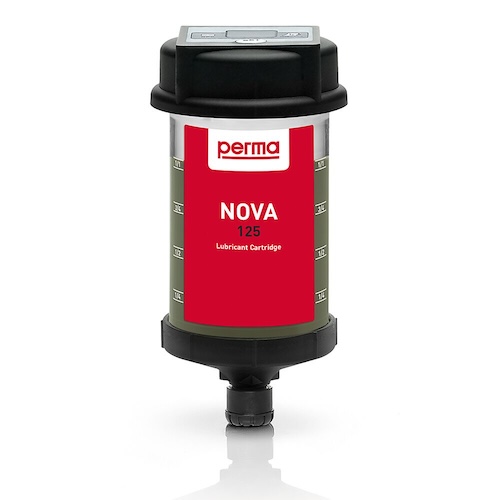
The advantage of an automatic lubrication cartridge is that it gradually injects grease into the bearing block via the lubrication point over a fixed set period. In this company’s case, for example, over six months. The cartridges only need to be replaced during the scheduled maintenance stop. Since the technicians no longer have to work between moving parts, this represents a huge improvement in their safety.
Chosen the perma Nova lubrication cartridge
No quote was needed, as the purchase of the lubrication cartridges could easily be covered by the maintenance budget. Since the semi-annual maintenance stop was scheduled for the following month, LE 4022 H1 Quinplex bearing grease filled perma Nova lubrication cartridges were purchased immediately for all lubrication points of the conveyor belt. The perma Nova lubrication cartridge was chosen deliberately because the ambient temperature does not affect its operation or dosing.
Switched all machines to automatic lubrication cartridges
A few months later, our specialist received a call from the company’s QHSE manager. She wanted to share how very satisfied she and the technical team were with the use of the automatic lubrication cartridges. They were so pleased that they requested a proposal to switch all machines in the company to automatic lubrication cartridges. This switch was eventually implemented, with the bonus benefits of reduced lubrication costs and a decrease in mechanical failures on rotating parts.