
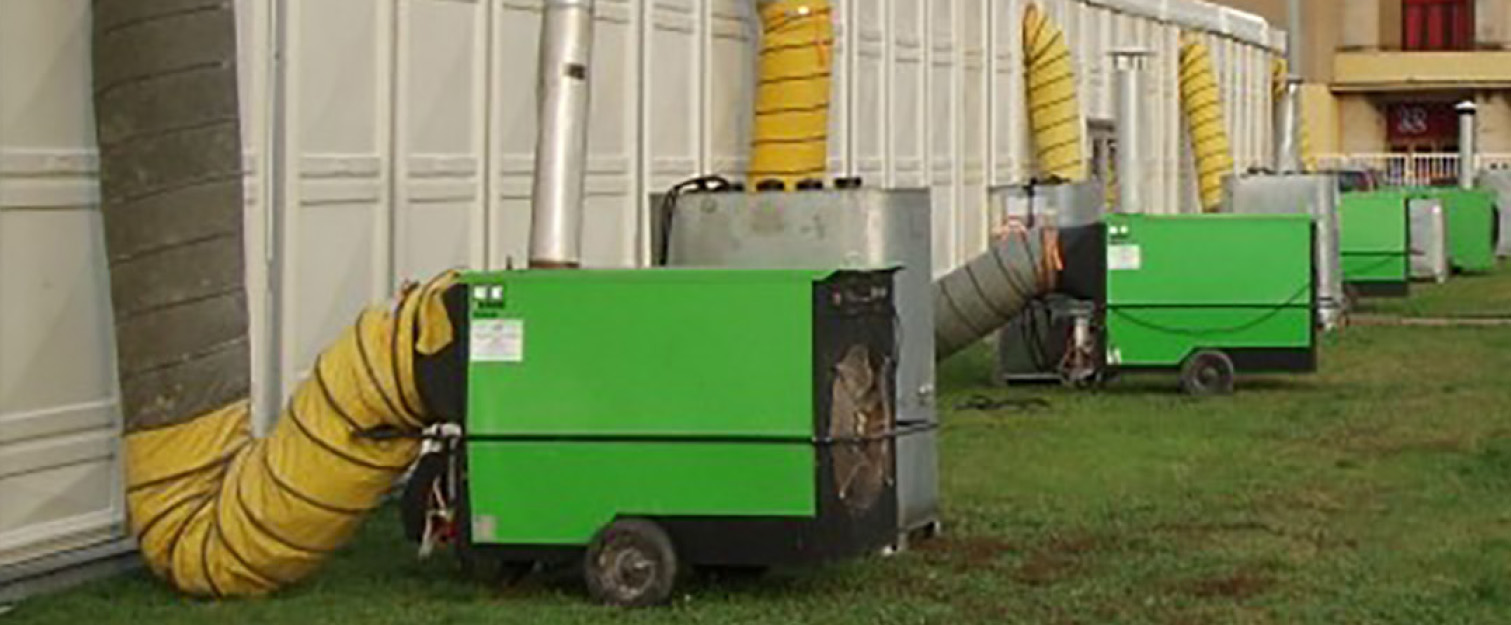
Starting in 2025, under new European and Dutch regulations, companies will be required to make their CO₂ emissions transparent. That may sound like an expensive and complicated task, but becoming more sustainable can be surprisingly simple.
Heating a space with a diesel heater might not seem sustainable. But that changes when you choose a biodiesel heater running on HVO100. This fuel has a much lower emission factor than natural gas or fossil diesel, which means your CO₂ emissions can drop by up to 80% with a single, simple switch. And the best part: you don’t need to replace your existing installation.
In this blog, you’ll learn what biodiesel is, how much CO₂ you can save with it, and why an energy-efficient heater or biodiesel heater makes all the difference.
What is biodiesel?
Biodiesel, also known as HVO100, is a synthetic diesel made from renewable residual streams such as used cooking oil and animal fats from the food industry. Because the fuel has no fossil origin, it is a much more sustainable alternative. A key advantage: HVO100 can be used directly in many existing diesel heaters without technical modifications.
What about the CO₂ emissions of biodiesel?
Because biodiesel is produced entirely from renewable sources, its emission factor is much lower than that of natural gas or fossil diesel.
Emission factors (2025):
- Natural gas: 2.134 kg CO₂ per m³
- Diesel B7: 3.251 kg CO₂ per liter
- Biodiesel HVO100: 0.441 kg CO₂ per liter
The result: with HVO100 you can reduce your CO₂ emissions by up to 80%. This gives you a simple lever to significantly lower your carbon footprint.
Natural gas vs. diesel vs. biodiesel heater
Suppose you heat a large commercial space with a 70 kW boiler that uses 10,000 m³ of natural gas per year. This generates about 21.3 tons of CO₂ emissions. If you switch to a standard diesel heater using Diesel B7 (approx. 10,600 liters), emissions rise to 29.3 tons of CO₂. If you use a biodiesel heater running on HVO100 (approx. 11,000 liters), emissions drop to just 4.8 tons of CO₂.
Conclusion: By heating with a biodiesel heater instead of natural gas, you can reduce your CO₂ emissions by 77%, and compared to regular Diesel B7 the reduction is 83%.
Temporary or supplementary heating. Biodiesel makes the difference.
For temporary applications—such as construction sites, tents, or relocatable halls for events and accommodation—diesel heaters are often used. By simply switching to biodiesel, CO₂ emissions can be reduced immediately and substantially.
For companies that are not yet ready to fully switch from natural gas to biodiesel, there is a smart interim solution: supplementary heating with biodiesel. This reduces the load on the natural-gas installation, and total consumption (and thus emissions) noticeably decreases.
Energy-efficient electric heater or biodiesel heater?
For smaller spaces or where sufficient electrical capacity is available, an energy-efficient electric heater is a good option. However, a biodiesel heater often provides more output, is easier to deploy on the move, and is less dependent on grid power. Ideal for large spaces, outdoor locations, tents, or temporary installations. Want to get the most out of your energy use? Combine smartly: use an electric heater for supplementary heating and a biodiesel heater for primary heating at larger sites.
Is biodiesel as good as fossil diesel?
Biodiesel (HVO100) delivers slightly less energy per liter than regular Diesel B7—the difference is up to 5%. In practice, you’ll barely notice it. Heaters run just as reliably.
On top of that, biodiesel burns cleaner, producing less soot and deposits in engines and heaters. The major advantage: your equipment stays cleaner for longer, and your emissions are up to 80% lower than with fossil diesel.
Is biodiesel easy to obtain?
In addition to being offered at more and more filling stations, HVO100 is also available through many fuel suppliers. They can often provide a mobile tank as well, so you can use your biodiesel heater worry-free throughout the winter.
Are Remko heaters suitable for biodiesel?
Yes, almost all Remko heaters are suitable for use with HVO100. The manufacturer has already taken biofuels like this into account in the design of the heaters.
In summary
If you’re looking for an energy-efficient heater for commercial spaces, events, or construction sites, biodiesel heaters are a smart choice. You drastically reduce CO₂ emissions, retain flexibility in placement, and don’t need any major technical modifications.

