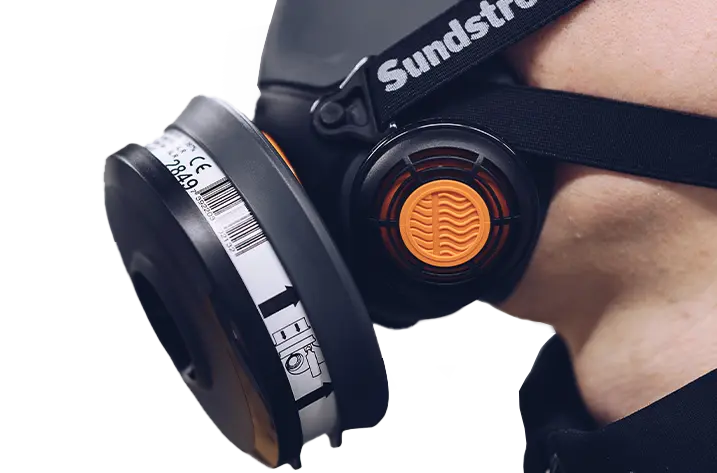
This is how the mechanisms behind a fine dust filter for respiratory protection work

A fine dust filter is often compared to a sieve. If the holes in the sieve are 1 mm in size, all particles smaller than 1 mm will pass through. Yet certain fine dust filters, like the P3 filter cartridges from Sundström, filter particles smaller than that smallest 1 mm hole. We’re happy to explain how this is possible.
Electrostatic and Mechanical Filters
Fine dust filters come in electrostatic and mechanical versions. Electrostatic filters capture particles because the filter material is statically charged—similar to a statically charged piece of PVC pipe attracting paper scraps. A drawback of this filter material is that the static charge fluctuates greatly due to factors such as temperature, humidity, airflow speed, filter age, and the amount of captured dust. Electrostatic filter material is commonly used in disposable masks and filter cartridges in budget half masks. Mechanical filters work quite differently. Think of them as a type of sieve, which is also capable of capturing particles that would normally slip through the smallest holes. To understand how this is possible, let’s take a look inside such a mechanical filter.
The Four Principles of a Mechanical Fine Dust Filter
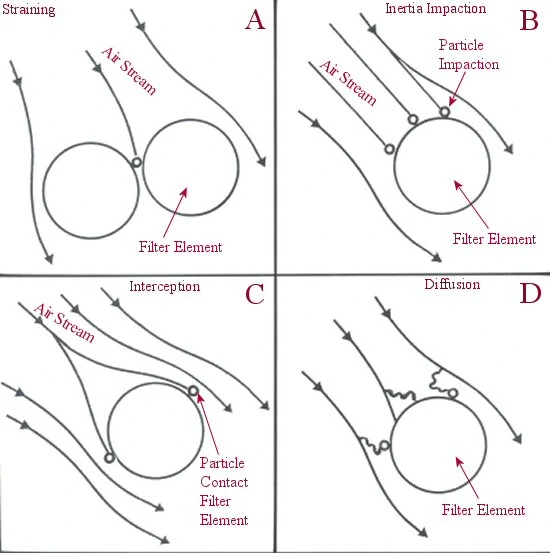
The operation of a mechanical filter is based on four principles:
A – Impaction:
If a particle is too large to move between the fibers, it gets trapped and captured. The more particles trapped, the narrower the space between the fibers and the more efficient the filter becomes. Think of it like a sieve that gradually fills up.
B – Inertia:
Depending on the shape, size, and density of the particle, it has a certain inertia. The path of a small heavy particle in an airflow changes less easily than that of a large light particle. When the airflow changes direction, the particle "flies" straight ahead and collides with the filter fiber. It is slowed down and captured.
C – Interception:
When particles pass through the gaps of the filter material, they brush against the fibers of the filter material sideways. This causes them to slow down and be captured.
D – Diffusion:
Ultra-small particles make irregular movements because they continuously collide with air molecules. Since they do not follow the airflow through the filter, they collide with the fibers of the filter material and are slowed and captured. This ensures that ultra-small particles, such as nanoparticles, are also captured.
Sixteen Times Better Than the Minimum Standard Requires
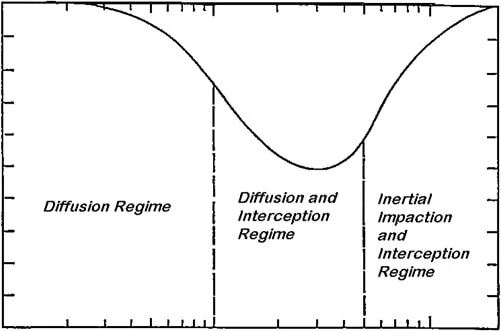
The combination of these mechanisms produces a curve with particle size on the horizontal axis and filter efficiency on the vertical axis. The particle size at which efficiency is lowest is called the MPPS, or Most Penetrating Particle Size. For Sundström’s SR 510 and SR 710 P3 filters, this is 0.4 µm (0.0004 mm) at a specific maximum airflow. The efficiency at this particle size for Sundström filters is 99.997%, which is more than 16 times better than the minimum required by the European standard for P3 filters. Particles both larger and smaller than this size are filtered even more efficiently!
Sundström tests every fine dust filter at the MPPS. Only when the filter efficiency meets their own standard of 99.997% (16 times better than the EU standard for P3) does the filter leave the factory.