
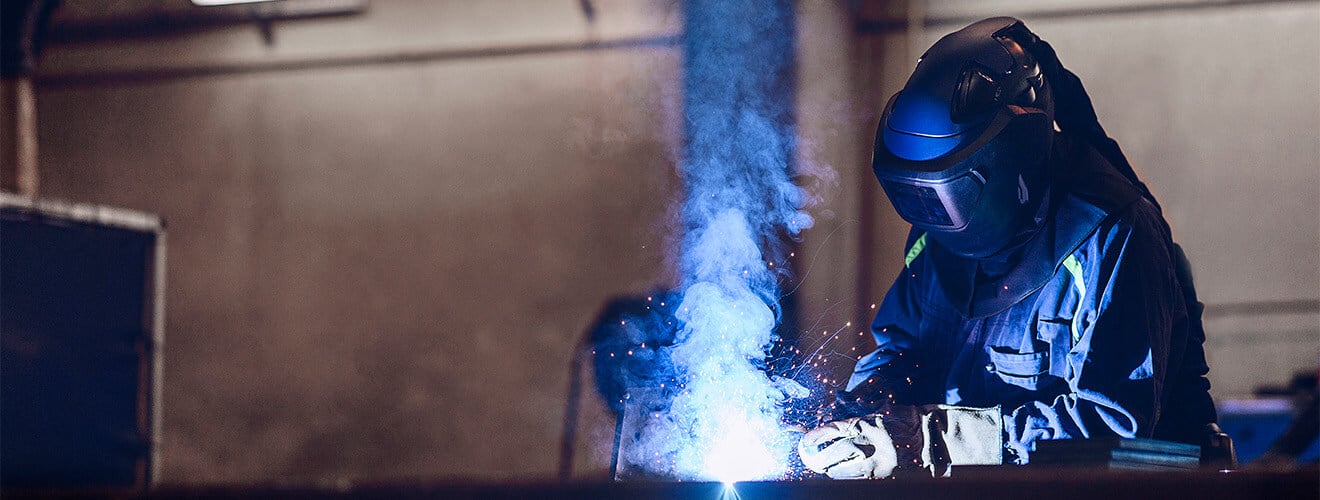
Welding fumes and welding smoke are internationally classified as Group 1 carcinogens for humans. This means they are considered a clear cause of cancer in humans (source: ECHA, European Chemicals Agency). It is therefore extremely important to prevent employees from inhaling welding fumes. We are happy to provide tips to help ensure they stay well protected and healthy.
Occupational Hygiene Strategy
Safety and occupational health officers are familiar with the occupational hygiene strategy. This strategy consists of four levels of measures to ensure that work is carried out as safely and healthily as possible. We follow this strategy and will show you how it is applied in practice to welding activities that release harmful welding fumes.
Level 1: Just not welding then?
The first level seems logical. If possible, avoid performing the task or choose an alternative process that involves fewer health risks. But with welding, that’s quite complicated, as only in specific cases can other processes offer a solution. Bonding metals with adhesives is a good alternative if it achieves the same goal and releases fewer harmful fumes during the exposure period. Connecting metal parts with fasteners like bolts is of course the best solution, but it’s not always feasible from a structural point of view.
Level 2: Remove welding activities from people
If measures at the first level aren’t possible, you should try to eliminate the risk from the people. For example, by having the welding done in an enclosed space by a welding robot. A robot performs very well for high-volume repetitive work. But when small series, custom work, or repairs are required, human hands are still necessary. Additionally, the investment in a robot can be so significant that welding is no longer profitable as a business activity.
Level 3: Limit exposure
This is the level at which many companies, often for economic reasons as well, can take action. A well-known example is a welding fume extraction system. This removes fumes from the workspace, reducing the concentration of toxic substances. However, such a measure also has its drawbacks. With an extraction system, it’s impossible to determine exactly how much the concentration of toxic substances is reduced. If the extractor is not properly positioned above the workspace, the welder may feel well protected while the welding fumes are poorly removed. Extraction alone does not always guarantee a completely safe welding environment but should be seen as a helpful tool to reduce the risk of inhaling welding fumes.
Level 4: Personal Protective Equipment (PPE)
Once all previous levels have been considered, personal protective equipment comes into play. Respiratory protection solutions for welding range from a half-mask with filters, worn under a welding helmet, to a complete system that blows clean, fresh air into the helmet. Such a powered air-purifying system offers the most optimal protection. However, even within these systems, there are differences in design and performance.
The Half Mask
Using a half mask with a P3 and A1 filter cartridge is a good solution for occasional welding. There are also disposable masks that contain carbon in the filter fabric. Although such disposable masks meet certain standards, they offer the minimum in terms of reliability and protection. This is mainly because achieving a proper seal on the face is often lacking—especially since it's quite easy to use a disposable mask incorrectly.

The Welding Helmet with Powered Air System
The airflow can be supplied either dependently via a motor unit with filter cartridges, or independently via the company’s compressed air system, connected to a filter unit that purifies the compressed air into clean breathing air. In an independent system, multiple users can sometimes be connected to one filter unit. The dependent system offers more freedom of movement, while the independent system requires less maintenance. Independent systems are often used when welding is mainly done in a fixed location and there is sufficient compressed air capacity.
For welders with beards, a powered air system is the only reliable solution.
Read more about it here.
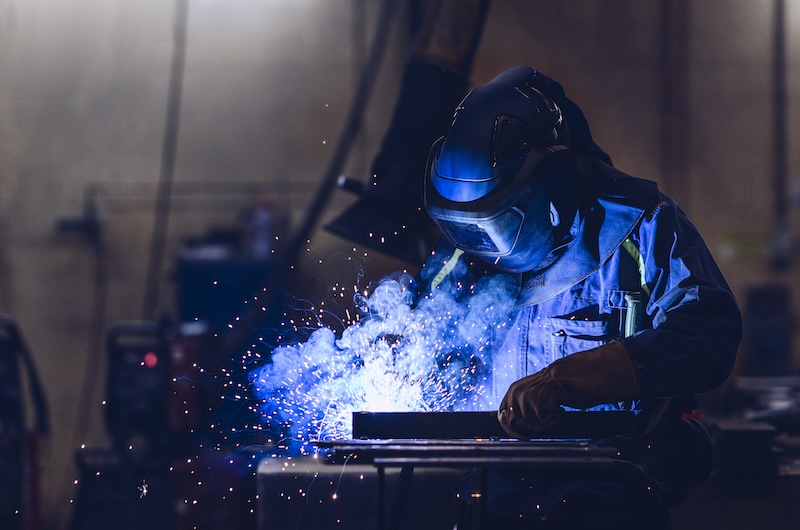
"Every disadvantage has its advantage"
The air blown by a motor unit is nearly the same temperature as the immediate environment. This is not the case with a compressed air system. Compressors often draw compressed air from outside the building. In winter, this air can be quite cold and dry, especially if it is conditioned (e.g., dried), as is the case in most companies. But every disadvantage has its advantage. During today’s warm summers, you get a wonderfully refreshing personal air conditioner in return. This can help welders literally keep a cool head and work comfortably even at high ambient temperatures.
Curious about the available solutions? Take a look through the online product catalog.
