
If you want to heat a workshop, warehouse, or tent, you will quickly end up considering mobile diesel heaters. In practice, choosing the right heater turns out to be more challenging than one might think. Mistakes are often made by selecting the wrong type of heater. The difference between a direct and an indirect heater determines whether a space can be heated safely, comfortably, and efficiently. On paper, both types of heaters generate warmth. In practice, the difference lies in how combustion and airflow interact. You notice this difference in the indoor climate, air quality, and energy consumption.
Direct Heater: Powerful, but not Suitable for Indoors
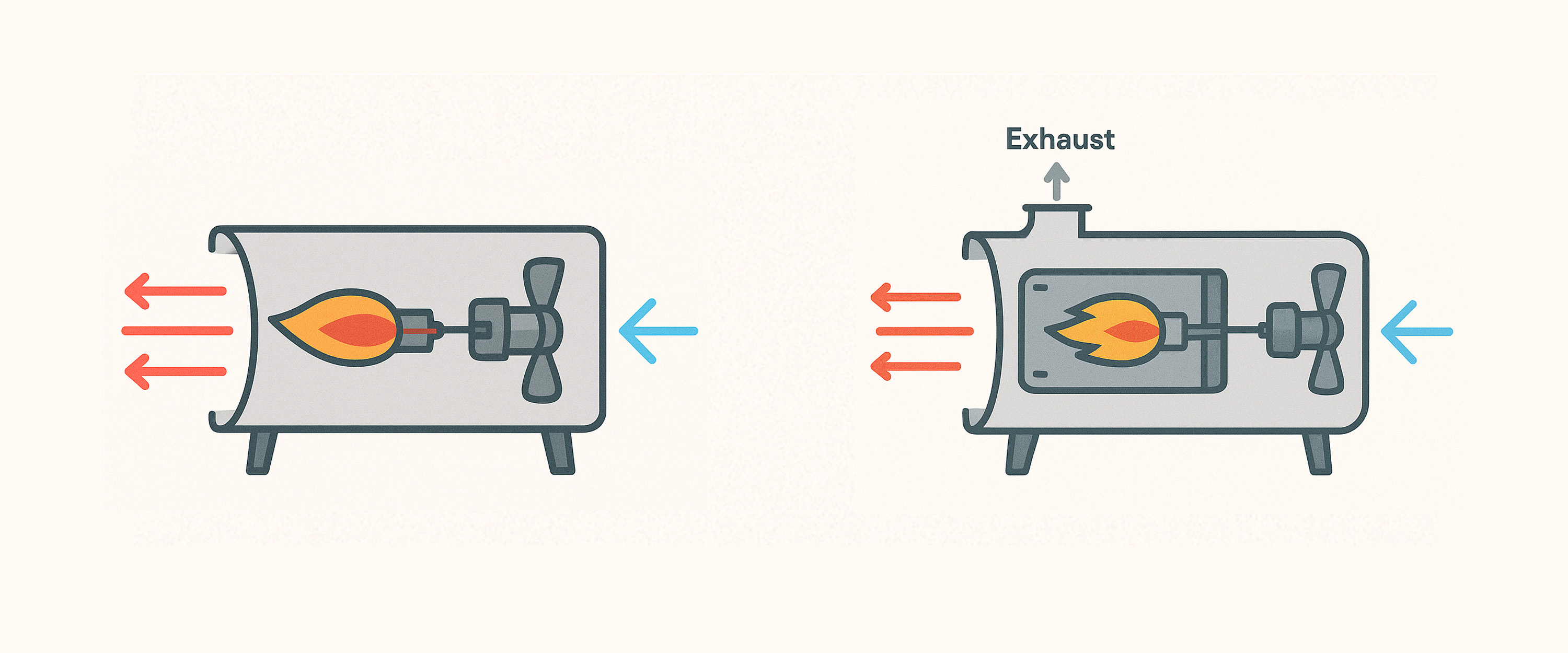
A direct heater burns fuel in an open chamber and blows the warm air directly into the space, including exhaust gases and water vapor. It's a quick and powerful solution for well-ventilated environments such as construction sites and open warehouses.
Once you use these diesel heaters in a closed space, problems arise. The air becomes contaminated, moisture accumulates, and condensation forms on materials and equipment. Ventilation becomes indispensable but also leads to heat loss. Direct heating means speed, but little control. It's best not to use this type indoors.
Indirect Heater: Controlled Heat
An indirect heater separates combustion and airflow. It works on a closed combustion principle. This means the fuel is burned in a sealed combustion chamber. The warm exhaust gases produced are not blown into the room but are guided past a heat exchanger, which transfers the heat to the airflow while keeping the gases contained. These gases are then neatly expelled via an exhaust to the outside.
The air you blow into the room is only heated, filtered air without smoke, moisture, or combustion residues. This keeps the air quality good and prevents condensation on materials and equipment.
The result:
- a dry and comfortable indoor climate
- less risk of corrosion or moisture problems
- a safer work environment for everyone spending extended periods in the space
Indirect heaters are often equipped with air hoses, allowing you to direct the warm air where needed. This makes them especially suitable for larger spaces or locations with multiple zones requiring heating. For workshops, tent structures, storage spaces, or warehouses, this is almost always the best choice. You keep the indoor climate under control, prevent damage to equipment, and ensure a stable, comfortable work environment.
Direct vs. Indirect: Differences Listed
| Aspect | Direct Heater | Indirect Heater |
|---|---|---|
| Air Quality | Exhaust gases remain in the space | Only clean air in the space |
| Moisture Production | Yes, due to combustion | No, dry air |
| Suitable for Indoors? | Only with intensive ventilation | Yes, also in closed spaces |
| Applications | Construction sites, open warehouses | Workshops, warehouses, tents |
| Efficiency Feel | Fast, direct heat | Slightly less fast, but more controlled |
When to Choose Which Type of Diesel Heater?
The right choice mainly depends on the conditions in the space. Are people present in the space? Does the temperature need to remain constant for a long time? Is there equipment sensitive to moisture? Then an indirectly fired heater is the only sensible choice.
Only in spaces with permanent ventilation or for outdoor use can a direct heater provide a solution. In almost all other situations, indirectly fired is not only more suitable but necessary. If you choose direct, you compromise on air quality, efficiency, and safety.
A second pitfall is choosing a heater model that is too light. The heater then runs continuously at full power without making the space really comfortable. This leads to wasted energy and frustration.
What Else Should You Consider?
Choosing between a direct or indirect heater is only the first step. The ultimate effectiveness of your heating setup also depends on technical and spatial factors. Consider:
- The volume of the space (in cubic meters)
- The degree of insulation
- The desired temperature difference
- The distribution of warm air in zones or directions
A tool like the Remko Heat Guide helps you quickly assess which diesel heater you need based on these variables. For more complex applications, such as tents with multiple compartments or workshops with sensitive machines, seeking advice is advisable. We are happy to provide you with custom heating advice.
With the right setup, you prevent energy loss, condensation issues, or comfort complaints. Heating should be reliable, not a source of extra work.
Conclusion: Direct or Indirect Heater?
The difference between a direct and an indirect heater seems technical but has direct consequences in practice. Air quality, moisture, safety, and comfort: it all depends on the type of diesel heater you choose.
Directly fired is meant for situations where ventilation is a given. Outside, on a construction site, or in an open warehouse. It’s simply not suitable for closed spaces.
For indoor use, or any situation where people, materials, or machines are present long-term, indirectly fired is the only logical choice. Clean air, dry heat, and controlled distribution make the difference between supplementary heating and professional heating.
The right heater prevents problems. And in most cases, that choice is less complex than it seems. Our specialists are happy to help you make the right choice. And if you're in doubt, you're always welcome to test our Remko diesel heaters first. For more information, also check out our Remko heaters page.

