
Why you should never assume the maximum working pressure for a hose
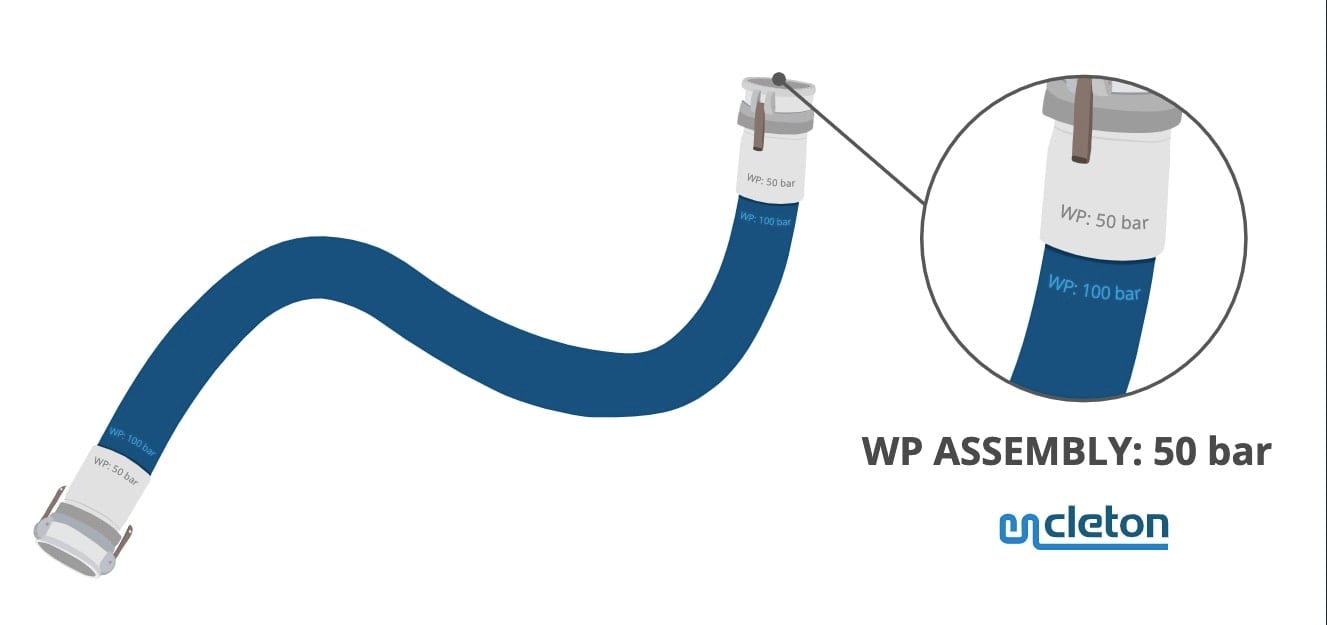
Every industrial hose is marked with a maximum working pressure in bar or psi. However, it is not safe to simply interpret this number as the maximum working pressure. Doing so can lead to potentially dangerous situations. Our experts explain why.
It’s Not Just the Hose That Has a Maximum Working Pressure
When you’re talking about a hose for professional use, you’re almost always referring to a hose assembly: an industrial hose with fittings assembled at both ends. These can be screw couplings, flanged couplings, camlocks, dry disconnects, or any other type of fitting. It’s not only the hose that has a maximum working pressure; the hose fittings also have a maximum working pressure specified by the manufacturer.
Exceeding the Working Pressure of the Fitting
The maximum working pressure of a fitting assembled to a hose is rarely the same as that of the hose itself. A hose may have a maximum working pressure of 100 bar, while the fittings are rated at 50 bar. If you operate at the working pressure indicated on the hose, you may be significantly exceeding the working pressure of the fitting. This creates dangerous situations. A fitting can come loose from the hose or disconnect spontaneously.
Supplier Specification
You should always base your working pressure on the total assembly: hose and fittings combined. Suppliers of hose assemblies will always specify a maximum working pressure for the entire assembly. This is often stated in the documentation accompanying the hose assembly. For example, 40 bar at 20°C. This is the pressure you should use. If your supplier hasn’t provided this, be sure to ask for it!
Data Quickly Available Through Smart Hose Management
But what if that information about the working pressure is stored somewhere in a binder in an archive cabinet, while you actually need it quickly? Having vital hose data readily available prevents hoses from being used incorrectly and thus unsafely. Digital hose management solves this problem. Through smartphone apps and dashboards on a laptop or desktop, you can immediately access important data related to a specific hose.