
Buying a professional pressure washer? How do you choose the right pressure washer for your needs?
15-04-2025
Whether you work in agriculture, industry, food processing or transport. A good high-pressure washer makes your cleaning operations significantly easier. But not every machine suits your application. With so many options on the market, choosing the right high-pressure washer can be challenging. Are you looking for a professional high-pressure washer for heavy contamination or a flexible solution for mobile use? In this blog, you will discover what really matters as a decision-maker: from pressure and water flow rate to drive system and service life.
When should you choose a professional high-pressure washer?
Not every professional high-pressure washer is suitable for intensive daily use. The difference lies in build quality, pump technology and load capacity. Do you operate the machine several hours a day or deal with heavy contamination? Then a professional model with robust components is not a luxury, but a necessity.
When is a professional high-pressure washer necessary?
Choose a professional high-pressure washer when the machine operates several hours per day, when there is heavy or caked-on dirt, when downtime causes direct costs or when reliability is crucial. For occasional use, a standard high-pressure washer is often sufficient. However, with 4–8 hours of daily use, a professional machine with a crankshaft pump and heavy-duty components is essential.
Pressure (Bar) vs. water flow rate (litres per hour)
When purchasing a high-pressure washer, people often first look at the number of bar. Understandable, but incomplete. Pressure determines how forcefully dirt is loosened, while water flow rate determines how quickly the loosened dirt is removed.
How much bar and water capacity do you need?
The right pressure and water output determine how efficiently you work. Here are some guidelines:100 - 150 bar: Vehicles and light contamination.
150 - 200 bar: Agricultural machinery and construction equipment.
200 - 300 bar: Concrete residues and heavy industrial applications.
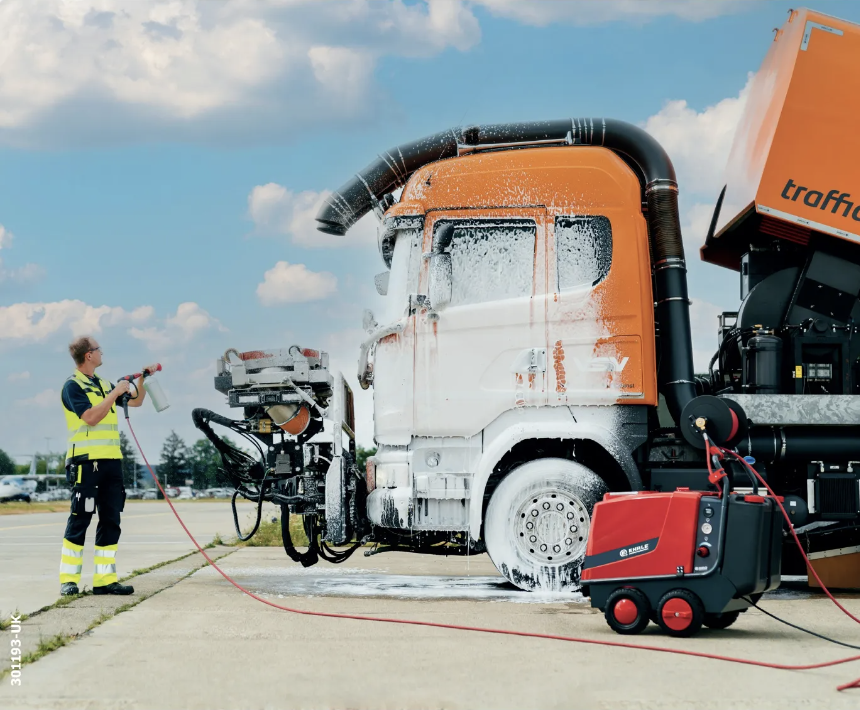
For the agricultural sector, cleaning trucks or cranes, you will quickly need at least 150 to 200 bar. If equipment is more heavily contaminated or used for industrial applications, a high-pressure washer between 200 and 300 bar is advisable.
In addition, water flow rate is at least as important:
600 - 900 L/h: Light applications.
1,000 - 1,500 L/h: Industrial standard.
1,500 - 2,400 L/h: Heavy cleaning and large surfaces.
High pressure without sufficient water output slows down the cleaning process.
Hot water or cold water high-pressure washer?
The choice depends on the type of contamination. We distinguish between hot water and cold water high-pressure washers.
- Hot water high-pressure washer: Suitable for grease, oil and caked-on residues. Widely used in automotive workshops, for cleaning heavy equipment and in the food processing industry. The food industry has additional requirements. These machines stand out due to a heat-resistant stainless steel pump that enables hygienic and thorough cleaning.
- Cold water high-pressure washer: Ideal for mud, sand, dust and construction dirt. Often more compact and lightweight. Suitable for transport, agriculture and public or recreational applications. Additionally, they are more energy-efficient and more affordable to purchase.
Why choose hot water?
- It reduces cleaning time;
- It lowers chemical consumption;
- It improves hygiene results;
For workshops, transport companies and food processing, a hot water industrial high-pressure washer is often the most economical long-term choice.
Which drive system should you choose: electric, petrol or diesel?
- Electric (230V): Limited power and suitable for lighter applications with a standard power supply.
- Electric (400V): Stable, powerful and ideal for fixed industrial installations. Suitable for 200+ bar and high water output.
- Petrol: No power supply required. Ideal for construction sites and agricultural applications.
- Diesel: Suitable for prolonged heavy-duty use without a fixed power source.
Electric high-pressure washers are available in both hot and cold water versions.
Technical features that make the difference
An industrial high-pressure washer must be built for continuous use. Therefore, pay attention to:
- Crankshaft pump (oil-lubricated): Ensures a longer service life.
- Ceramic plungers: Wear-resistant under high load.
- Brass pump head: Resistant to high pressure and temperature.
- Thermal protection: Prevents overheating.
Cheaper machines with axial pumps are not designed for long-term industrial use.
Choose capacity that matches your application
Every application is different. Factors such as daily operating hours, type of contamination and available power supply determine which industrial high-pressure washer is best suited. Invest in capacity that matches your workload and prevent unnecessary downtime or additional costs. Our specialists are happy to help you select the right configuration, so you choose certainty, durability and return on investment.
