

Challenges with EV fast chargers in measuring for MID directive
18-06-2026
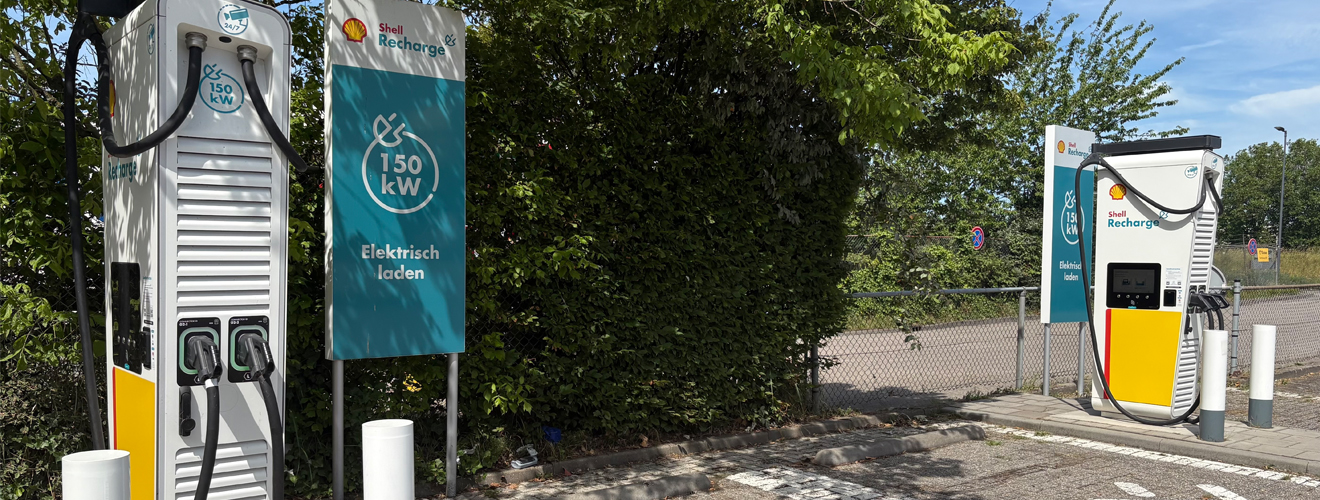
The charging infrastructure for electric vehicles is rapidly developing. While charging stations were previously mainly AC charge points with relatively limited power, we are increasingly seeing DC fast chargers and high power chargers along highways, at logistics hubs, industrial parks, and public charging stations. This development requires new standards for measurement, testing, and calibration.
With the updated European MID directive (EU) 2026/706, harmonized requirements are introduced for the first time for measuring systems in charging infrastructure for electric vehicles. For operators, this means they must demonstrate that the measuring equipment complies with legal requirements. Measurement accuracy, certification, control, and documentation are becoming increasingly important aspects of professional charge infrastructure management.
Managing DC charging stations is technically more challenging than managing AC charging stations.
Why DC chargers are more challenging to test than AC charging points
For AC chargers, testing and controlling the energy measurement is relatively straightforward. The power levels are lower, the currents more limited, and the measurement conditions often easily reproducible. This is different for DC chargers.
A DC fast charger delivers large amounts of current in a short period. Consequently, the currents increase significantly, and the charging profile continuously changes. An electric car does not consistently demand the same power. The charging curve is influenced by factors such as battery temperature, battery management system (BMS), vehicle software, and charging strategy. It's crucial not only to know if a DC charger works but also if the delivered energy is measured correctly under varying practical conditions.
High currents in short periods require specialized equipment
One of the biggest challenges with DC chargers is the combination of high currents, high voltage, and short test durations. Especially with high power charging, currents can rise to hundreds of amps in a short time. In HPC systems, currents can reach up to 500 A or more. This demands test equipment that remains safe, reliable, accurate, and stable under heavy load.
Measuring under realistic conditions
A reliable check of a DC charger requires measurements as close to real-world conditions as possible. The testing equipment must therefore be usable directly on-site and suitable for the conditions in which charging stations operate daily.
EMOB testing boxes from ZERA
The German company ZERA GmbH has developed the EMOB series for testing AC and DC charging infrastructure.
The EMOB200 is suitable for AC and DC charging stations with measurements up to 32 A AC and 200 A DC via Type 2 / CCS2 ports among others. For heavier DC charging stations and HPC applications, ZERA offers the EMOB500, suitable for DC measurements up to 500 A with a CCS2 connection.
The EMOB testing boxes are compact solutions for direct measurements on the consumer and charging station. The equipment is developed for checks during maintenance, verification after changes, and assessment of measurement performance. It also supports billing according to legal metrology rules.
This makes it possible to test not only in a laboratory setting but also at existing installations in the field. This is essential for operators. After all, the measuring equipment of a charging station must not only perform within standards upon delivery.
For operators, it is important to keep insight into the performance of the measuring equipment throughout the lifecycle of a charging station.
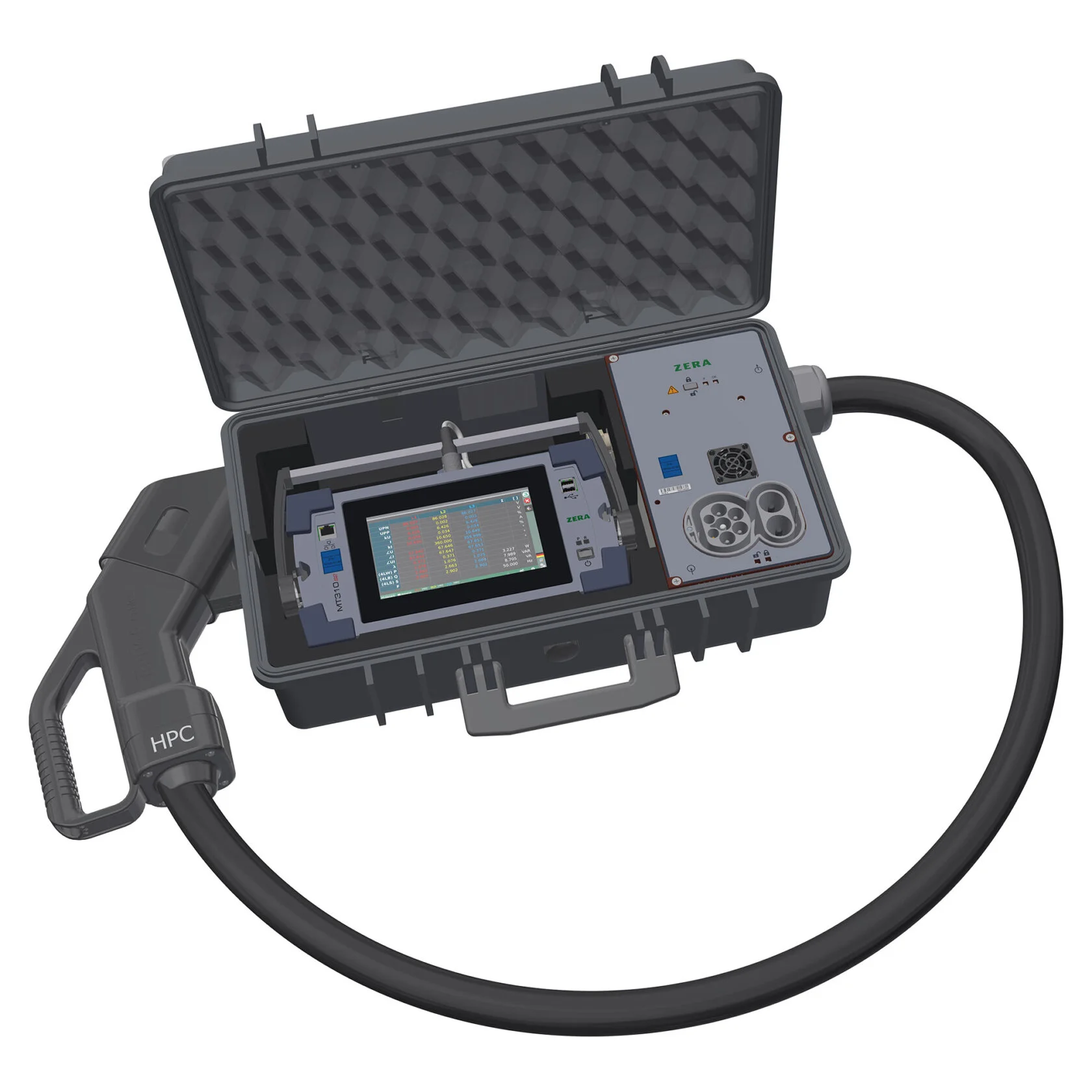
The Zera EMOB500 testing device for testing and verifying DC fast chargers.
Safety; an important aspect of testing
For DC chargers, testing goes beyond mere measurement accuracy. Due to high currents and voltages, safety plays a significant role. Testing equipment must prevent technicians, service engineers, or inspectors from facing unnecessary risks during connection, measurement, and disconnection.
The EMOB test cases from ZERA therefore include reliable safety features such as checking for proper cable contacts, cable type detection, and electromechanical locking of connections. Additionally, for DC applications, the high-current contacts are monitored for overcurrent. The EMOB80, EMOB200, and EMOB500 also monitor the temperature of AC and DC contacts; when a pre-set temperature is reached, the charging process is automatically shut down.
This is certainly not a luxury. With high DC currents, heat development can occur quickly. A poor connection, damaged connector, or contaminated contact transition can affect measurement safety and reliability.
Accuracy in interference-rich charging environments
Charging stations are electrically complex installations. Power electronics, switching frequencies, and harmonics of switching frequencies can affect measurements. Especially in DC fast chargers, a reliable reference measurement is therefore not self-evident.
The EMOB test kits have a high accuracy of 0.1% of power. The reference meter used is insensitive to interference frequencies up to 150 kHz, which can be relevant in the vicinity of charging stations.
Our experts assist in preparation for the new MID directive
For operators of charging stations, service companies, and inspection bodies, this is the time to look ahead. The new MID directive provides more uniformity and clarity but also requires knowledge, processes, and suitable testing equipment.
As the Benelux distributor of ZERA equipment, we help organizations prepare for this development. With specialized testing and control equipment for AC and DC charging stations, measurements can be performed safely, accurately, and demonstrably. This helps organizations to make their measurement performance demonstrable and to maintain trust with users and clients. But also to build trust with EV drivers.
Want to know more about measurements on DC charging points?
Meer artikelen over testen en controleren
Energy & Industry
From maintenance to measurement certainty: a new role for charging station service companies
From maintenance to measurement certainty: how the role of charging station service companies is changing
Energy & Industry
Ready for the new MID directive? Prepare your charging points in 8 steps
Ready for the new MID directive? Prepare your charging infrastructure with these 8 steps.
Energy & Industry
New MID guideline establishes uniform requirements for measuring during EV charging
New MID directive sets uniform requirements for measuring EV charging with implications for operators