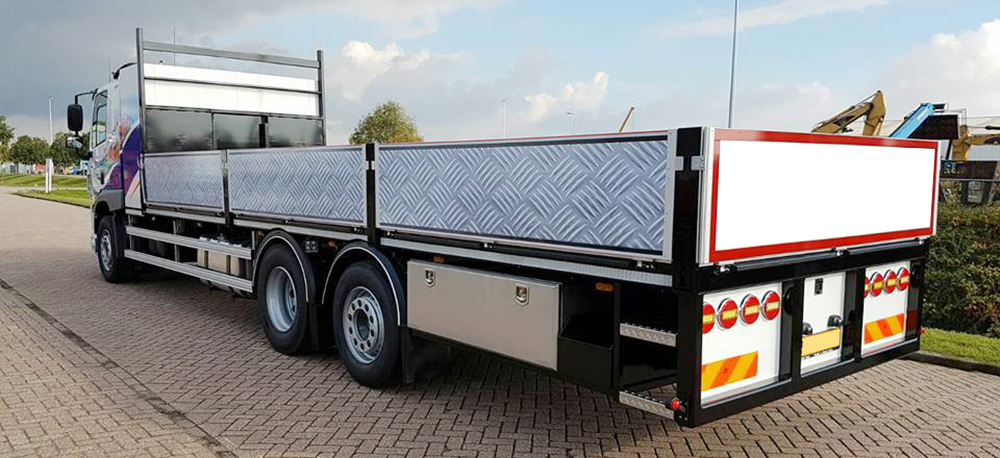
Every minute counts in the bodywork construction industry. The schedule is tight, and the pressure on the workshop is high. As a bodywork builder, you know that a reliable construction of an open flatbed or trailer begins with smart choices in materials and assembly. Side panels play an important role in this. In practice, side panels are often assembled late in the construction process. These involve loose profiles and parts that still need to be assembled and customized in the workshop. This costs extra assembly time, increases the chance of errors, and requires extra workspace. By choosing pre-assembled aluminum side panels, this process can become simpler and more predictable.
What are custom side panels?
Custom side panels are short, foldable panels for open flatbeds, trailers, and trucks, where dimensions and attachment are precisely tailored to the bodywork in advance. These panels limit the load and, at the same time, provide accessibility to the loading area. Thus, side panels are a functional and visible part of bodywork construction.
Since the dimensions and attachments are set in advance, these panels can be directly mounted onto the construction without additional adjustments in the workshop. Instead of standard solutions that need to be adjusted later, you receive side panels that fit the construction process from the start and align with the vehicle's use.
Why standard side panels often lead to extra work
In practice, standard side panels rarely fit perfectly the first time. They are often chosen due to availability or flexibility. Bodywork builders frequently need to adjust these panels while the rest of the construction continues. Especially with repetition or series production, the work piles up. What starts as a small correction per vehicle quickly grows into a structurally extra burden in the workshop and a less predictable schedule.
What do custom side panels mean for assembly and lead time?
Aluminum side panels or steel side panels?
The material choice greatly determines how the side panels behave during use. Depending on the application, aluminum or steel is often chosen. Aluminum side panels offer advantages in terms of weight and corrosion resistance, while steel is mainly used for heavier applications where robustness is important. The chosen materials directly affect the vehicle's weight, the construction's lifespan, and the ease with which the side panels can be mounted.Good preparation
Good preparation is essential for smooth assembly. This includes pre-determining the exact dimensions of the bodywork, the position of the side panels, the attachment points, and the application of the right fittings. By working with a broad range of board wall profiles, it is possible to assemble side panels that fit virtually any open construction. Depending on the application, different versions can be chosen, such as anodized or plain aluminum.The fittings are also tailored for practical use. Various types of hinge and lock solutions are possible, such as pin, lever, or built-in locks. By defining these choices in advance, the side panels fit well technically on the vehicle, and extra adjustment work in the workshop is minimized. This method aligns with how more bodywork builders are intelligently organizing their assemblies and outsourcing assembly within bodywork construction.
When is customization interesting?
Having side panels made to measure in advance is particularly interesting when standard side panels still need to be adjusted in the workshop when lead time is under pressure or when there is repetition or series production. Also, if predictability in assembly and scheduling is important, customization offers a clear advantage. In these situations, custom side panels provide immediate time savings and a more manageable process.Support for custom side panels
Summary
Custom side panels contribute to more efficient bodywork construction by establishing dimensions and assembly in advance. This leads to less work in the workshop, a shorter and more predictable lead time, and reduced failure costs. This not only decreases assembly time and repair costs but also the total cost across the entire construction process (TCO).Want to know if custom side panels fit within your construction process? We are happy to think along with you.