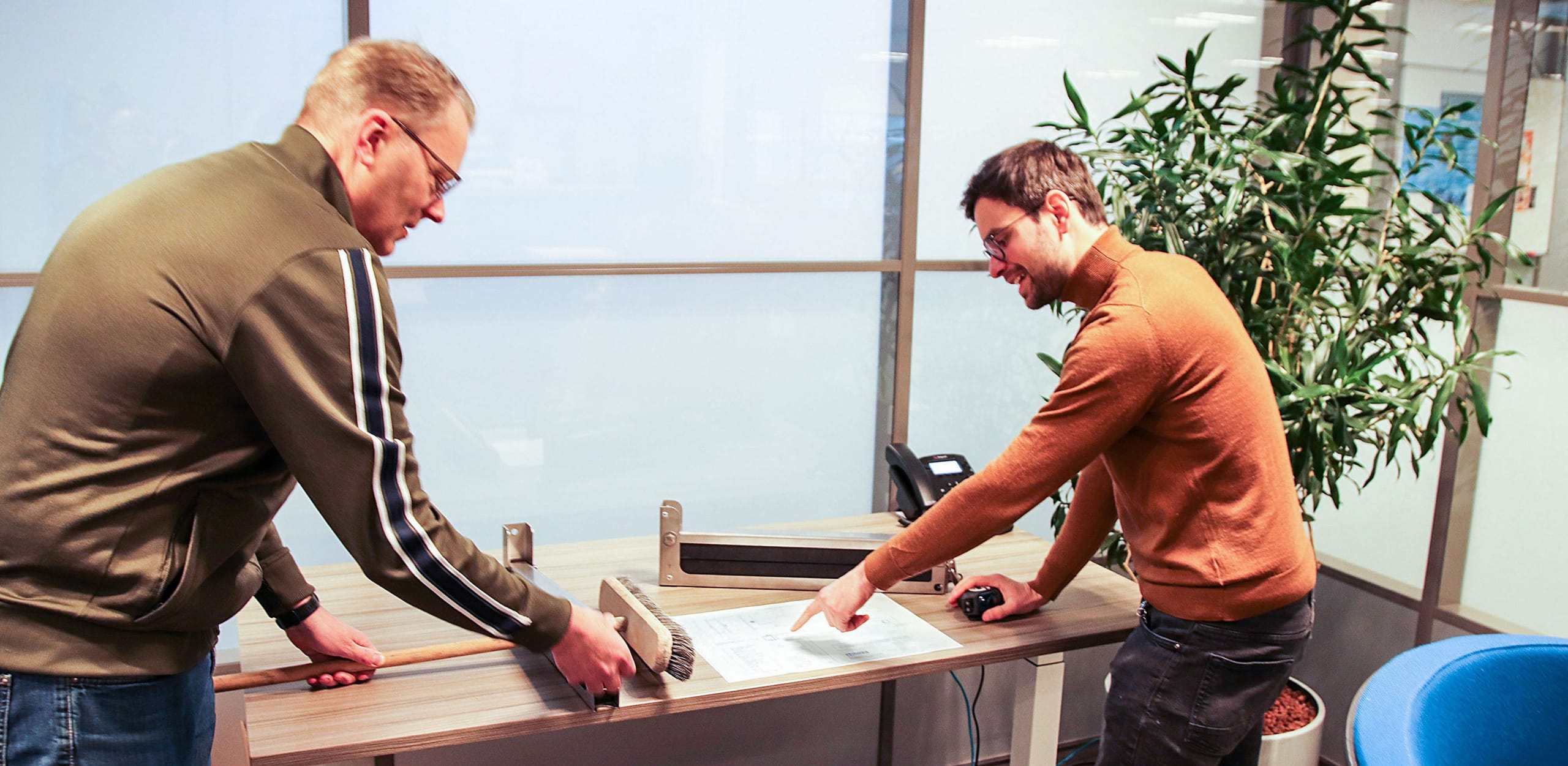
Gertjan van de Veer is product development engineer at Imbema Transport and Logistics. Together with colleagues, he runs a unique department within Imbema which focuses solely on product development and innovations. We wanted to find out what he is currently working on and where he gets his inspiration from, so we decided to talk to him.
Development of new products
“My main task is to develop new products, and that’s also what I like doing best. But developing new products takes time and money. I often get asked whether I can ‘just’ make something, but that’s not how it works. A mould, i.e. the plastic tooling, can cost as much as ten thousand euros. The process of developing a new product always starts with a business case, as it’s a waste to spend hours on something if it’s not viable. Once we have decided to develop a product, all kinds of things enter into the picture. Besides the design, printing of 3D prototypes, construction and testing, you also have to deal with administration, assembly and various suppliers. Once I have developed something, the organisation takes over from me so that we can get on with the next project. But it’s definitely worth it! Over the past few years, I have been able to develop some great products such as a broom clip, a range of load securing solutions, the Easy Aero roof fan, various SBS lock solutions and a step for vans."Easy Aero roof fan
“The Easy Aero in particular is a unique product. When designing this product, I got rid of all the drawbacks of traditional roof fans. The extraction system with rotating parts was replaced with powerful push and pull technology. This makes the roof fan a lot less vulnerable and you no longer require floor drainage, which prevents serious damage to the van’s exhaust, wiring and braking system, for example. It’s also handy for electric vans where the battery pack is hidden away underneath the floor.” Read more about the Easy Aero roof fan.
“My latest innovation is a new step for vans, which we designed it in collaboration with a customer. the safety of our user was our top priority”
Versatile step for vans
“My latest innovation is a versatile step for vans. We designed it in collaboration with a customer and it will soon be available to other customers too. When designing this step, the safety of the user was the top priority. The step is extra wide and has a punched perforated profile for grip when wearing work boots. The modular design of the step is also a major benefit. For example, the customer can opt for an extra profile at the back of the step to stop your foot from slipping between the step and the registration plate. If you opt for sensors, the same profile can be mounted on the front of the step. When the sensors are not in use, a rubber bumper can be fitted to stop you from knocking your shins.”SBS trailer lock: The Hornet
“We are also busy working on the further development of our SBS trailer locks. The current SBS Inlock locks are fitted to the inside of the trailer door. In some cases, a lock can take up the same space as a pallet, but that’s a waste of space. To prevent that, we developed a new lock called the Hornet. The new Hornet trailer lock has the same functionalities as the well-known SBS locks but with a more compact housing. The Hornet lock is mounted differently so that the load capacity of the vehicle is not reduced."Optimising products through value engineering
Gertjan organises value engineering sessions in order to keep challenging himself and his colleagues. “In short, it’s about opening up people’s mindset. A value engineering session is about colouring outside the lines, throwing all kinds of ideas into the mix in order to end up with new solutions”, explains Gertjan.The relationship between customer, requirements and resources
Gertjan came across the method of value engineering while studying for his Master’s degree in Engineering. “The main objective is to find out how the components of customer, requirements and resources relate to each other. Why is the product falling short? The task can be accomplished so much quicker when you’re working with other people. During the session, you mainly generate lots of ideas and write down everything that comes into your head. That process of writing everything down is called brainwriting. “You literally get as much as you can out of the group, nothing is regarded as too crazy. The most important thing is for everyone to be on the same page. Then later on, you can start funnelling the ideas”, explains Gertjan.